
Zones of Regulation & The 3Rs
A Parents' Guide
At Pirbright, your child’s emotional wellbeing is just as important as their academic learning. We know that in order to move up The Pirbright Pyramid and reach their academic potential (and beyond!) they need to be able to regulate their emotions in order to access all the challenges that school (and life!) can bring them. One of the ways we support this is through a framework called The Zones of Regulation. The Zones of Regulation is the first step in ours 3Rs which is where we help children to Regulate (Zones of Regulation), Relate (Emotion Coaching) and Reason (Restorative Approaches).
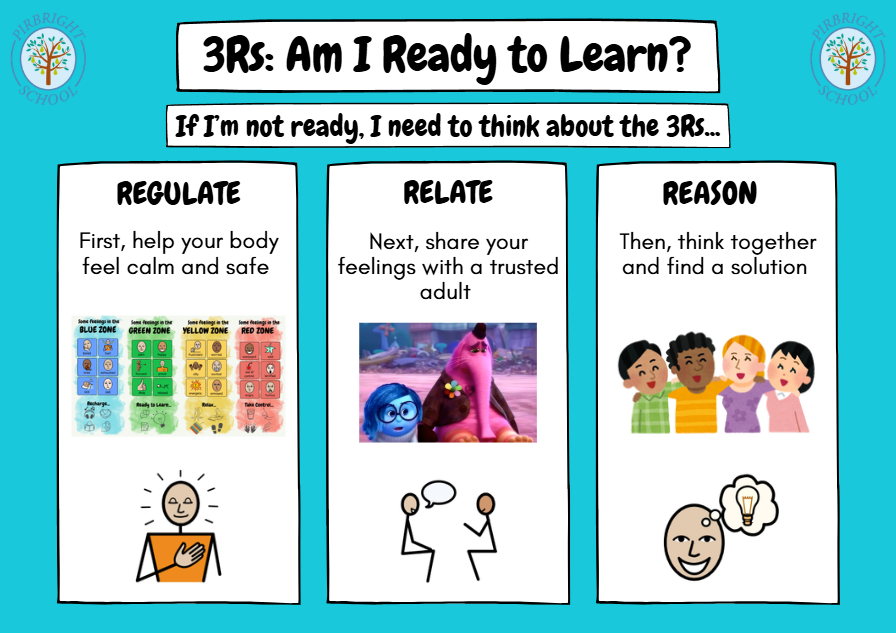
What are The Zones of Regulation?
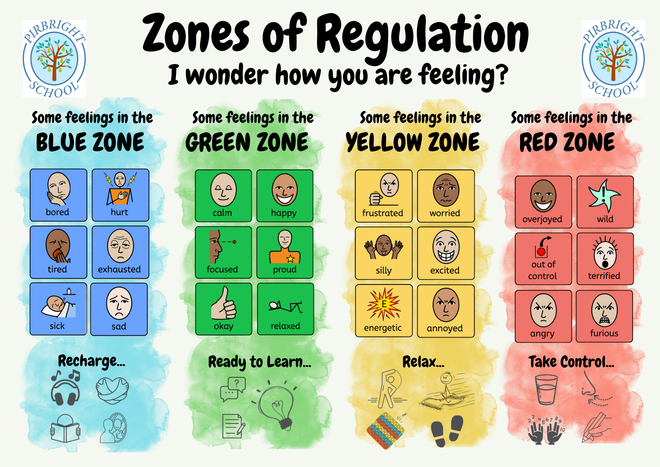
The Zones of Regulation are a simple, child-friendly tool that helps children understand and manage their emotions. They break down feelings into four coloured “zones”.
- Blue Zone: Feeling sad, tired, sick, or bored.
- Green Zone: Feeling calm, happy, focused, and ready to learn.
- Yellow Zone: Feeling anxious, excited, frustrated, or silly.
- Red Zone: Feeling angry, terrified, or out of control.
A person who can self-regulate is able to
• Remain CALM AND ORANISED in a stressful situation. (Executive Functions)
• Cheer themselves up after a disappointment. (Emotional Regulation)
• Know when they are experiencing sensory overload and can make adjustments. (Sensory processing)
• Understand when it is appropriate to cheer and shout and when to be quiet. (Social cognition)
It’s important to know that there’s no “bad” zone—all emotions are normal. The goal is to help children recognise how they’re feeling and learn strategies to help themselves when they need support.
Why Do We Use It in School?
Every child experiences big emotions throughout the day. Whether it's excitement before a trip, nervousness about a test, or frustration during play; it's important they have the tools to handle these feelings.
By using the Zones of Regulation across the school:
- We give children a shared language to talk about emotions.
- We help them build self-awareness and self-regulation skills.
- We support a calmer, more focused classroom environment.
- We encourage empathy by helping children understand how others may be feeling.
How Will It Help My Child?
The Zones of Regulation help your child to:
- Understand and label their feelings with confidence.
- Use calming or energising strategies to get back to the “Green Zone” when needed.
- Develop resilience and positive coping skills that they can use in and out of school.
- Improve focus, social skills, and emotional independence.
By learning these skills early, children are better equipped to manage challenges, solve problems, and thrive both in the classroom and beyond.
Things to Remember
• There is no ‘bad’ Zone.
• Everyone experiences all of the Zones at different times and in different circumstances.
• We can’t change the way children feel BUT we can help them manage their feelings/states and behaviours. “It’s OK to be angry but it is not OK to hit…”
• You can be in more than one Zone at a time (eg. sad and angry).
If your child is confidently using words to describe their emotions, they don’t need to revert to Zones language. HOWEVER it is useful for them to know the strategy groups that will help them. Eg. sick or tired = blue zone strategies
If your child is in the Red Zone…
- Limit verbals – this is not a teachable moment
- Discuss use of tools when child is regulate
- Plan for if/when child is in Red Zone. “I wonder if this strategy would help…?”
Emotion Coaching
At Pirbright we are all trained in Emotion Coaching, which forms part of Zones of Regulation. Emotion coaching is when adults help children understand and manage their feelings by noticing emotions, listening with empathy, and guiding them to find better ways to cope or solve problems. We use the following phrases to support children...
"I can see you are... I wonder if..."
For example, I can see you are very angry. I wonder if a drink of water and a small snack would help you to feel better and then we can have a chat and work out what to do next?