
Inclusion
At Pirbright Village Primary School, we provide a broad, ambitious and engaging curriculum that enables every child to flourish academically, socially and personally. Inclusion is at the heart of our approach: every child is known as an individual, valued for their unique strengths and supported to achieve their full potential within a culture of high expectations and belonging. Every member of staff shares responsibility for ensuring that learning is accessible, ambitious and appropriately adapted so that all pupils, including those with special educational needs and disabilities, can participate fully and achieve highly. Through adaptive teaching, strong relationships and an unwavering commitment to equity, we ensure every child has the opportunity to thrive.
At Pirbright Village Primary School, we are committed to ensuring that teaching is shaped by the best available evidence about how children learn most effectively. We recognise that high-quality, consistent classroom practice has the greatest in-school impact on pupil outcomes, and therefore place professional development at the heart of our continual improvement.
Our Inclusive Approach
Through high-quality teaching, thoughtful adaptations and a nurturing environment, we aim to remove barriers to learning and enable every child to thrive. We recognise that children learn in different ways and at different rates, and we work collaboratively with families and external professionals to ensure that the right support is provided at the right time. Our approach is proactive, inclusive and centred on helping every child develop the confidence, independence and resilience they need to succeed.
- High quality first teaching for all pupils
- Early identification of additional needs
- Adaptive teaching within the classroom
- A graduated approach to support
- Strong partnerships with parents
- Working alongside external professionals
- Promoting wellbeing alongside academic achievement
- Celebrating diversity and belonging
Who We Support
Inclusion at Pirbright Village Primary School extends far beyond Special Educational Needs and Disabilities (SEND). We are committed to supporting all children who may require additional provision, whether this is short-term or ongoing. This includes children with SEND, those with English as an Additional Language (EAL), pupils eligible for Pupil Premium funding, children with medical needs, young carers, looked after and previously looked after children, and those who may need support with attendance, emotional wellbeing or other barriers to learning. By recognising and responding to each child's individual strengths and needs, we ensure that every member of our school community has the opportunity to achieve their very best.
- Special Educational Needs and Disabilities (SEND)
- Pupil Premium
- English as an Additional Language (EAL)
- Children with medical needs
- Looked After (LAC) and Previously Looked After Children (PLAC)
- Young Carers
- Children with attendance or emotional wellbeing needs
- More Able Learners
- Children experiencing temporary difficulties
- Children at risk from safeguarding issues
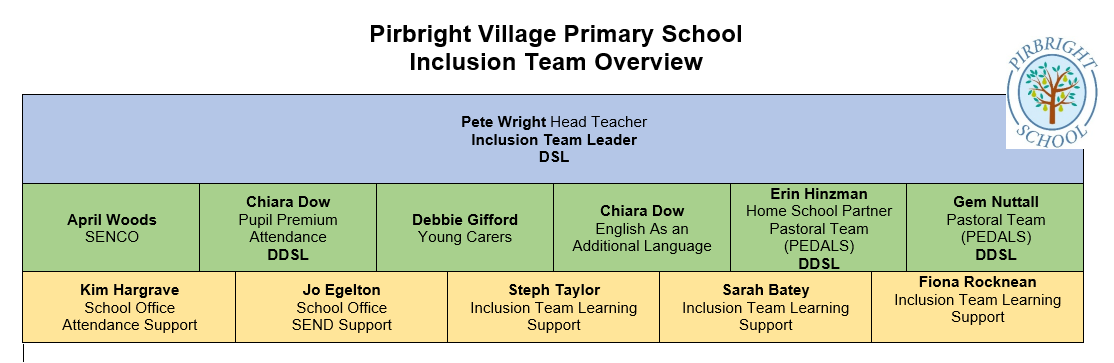
Meet the Team
Inclusive Practice Examples at Pirbright - Click to Expand
Behaviour and Relationships
|
Calm, orderly classrooms where expectations are clear and routines are secure. Children feel safe, respected and valued, enabling them to engage fully in learning. Strong, positive relationships between staff and children support effective behaviour for learning, reduce disruption and create an environment where all children are ready to learn and can make sustained progress. |
|
Curriculum Planning
|
Learning is logically sequenced and builds progressively over time. Children develop secure understanding, make meaningful connections between concepts and retain knowledge more effectively. Children are better able to apply their learning confidently across subjects and year groups, leading to sustained progress and deeper understanding. |
|
Explaining and Modelling
|
Children understand complex ideas and develop secure schemas. This supports children in making connections between prior and new knowledge, reducing cognitive load and increasing retention. Children are better able to apply their learning independently and with confidence across a range of contexts. |
|
Questioning and Feedback
|
Children’s understanding is continuously checked and misconceptions are addressed in a timely way. Teaching can be adapted effectively, moving learning forward and deepening understanding. Children make stronger progress, develop greater independence and are better able to articulate and apply their learning with confidence. |
|
Practice and Retrieval Building
|
This strengthens recall, reduces cognitive load and enables children to build on prior learning more effectively. Children become increasingly confident and accurate in applying their knowledge across the curriculum. |
|
At Pirbright, retrieval practice is woven throughout teaching and learning rather than viewed as a standalone strategy. We recognise that pupils learn more effectively when they are regularly required to recall, revisit and apply previously taught knowledge and skills, strengthening long-term memory and supporting the development of secure foundations for future learning. Our chosen tools naturally embed retrieval through strategies such as Think-Pair-Share, Cold Calling, Show-Me Boards, Check for Understanding and Make Everyone Think. These approaches ensure that all pupils actively engage with prior learning, enabling teachers to identify misconceptions and adapt teaching accordingly.
Retrieval is embedded across the curriculum. In English, pupils revisit key knowledge and skills before beginning their learning for the day. In mathematics, regular retrieval develops fluency and automaticity in key facts, methods and concepts through the use of White Rose Flashback 4 tasks.
Across science and the wider curriculum, every lesson begins with a consistent learning slide – a Learning Launch - that provides pupils with the context for learning, including the subject, area of study and learning objective. Pupils then complete a retrieval activity based on prior learning, either from the current unit or from previous year groups, helping to strengthen long-term memory and make connections across the curriculum. Key vocabulary is explicitly revisited and introduced to support understanding and language development, while opportunities for metacognitive reflection encourage pupils to consider the knowledge, skills and strategies they will need to be successful in their learning. Through these carefully planned retrieval opportunities, pupils deepen their understanding, strengthen retention and build secure foundations for future learning.
Mode B Teaching
|
Learning is extended beyond recall, supporting children to apply knowledge flexibly and creatively. As a result, children develop greater confidence in reasoning, communication and independent thinking across the curriculum. |
|